
TANZANIA BANKING PERFORMANCE AND OUTLOOK: AN INDUSTRY EXPANDING FASTER THAN ITS PROFITS
TANZANIA BANKING PERFORMANCE AND OUTLOOK: AN INDUSTRY EXPANDING FASTER THAN ITS PROFITS
Prepared by Reginald Massawe | Managing Director, AML Finance Limited
1.0 Overview
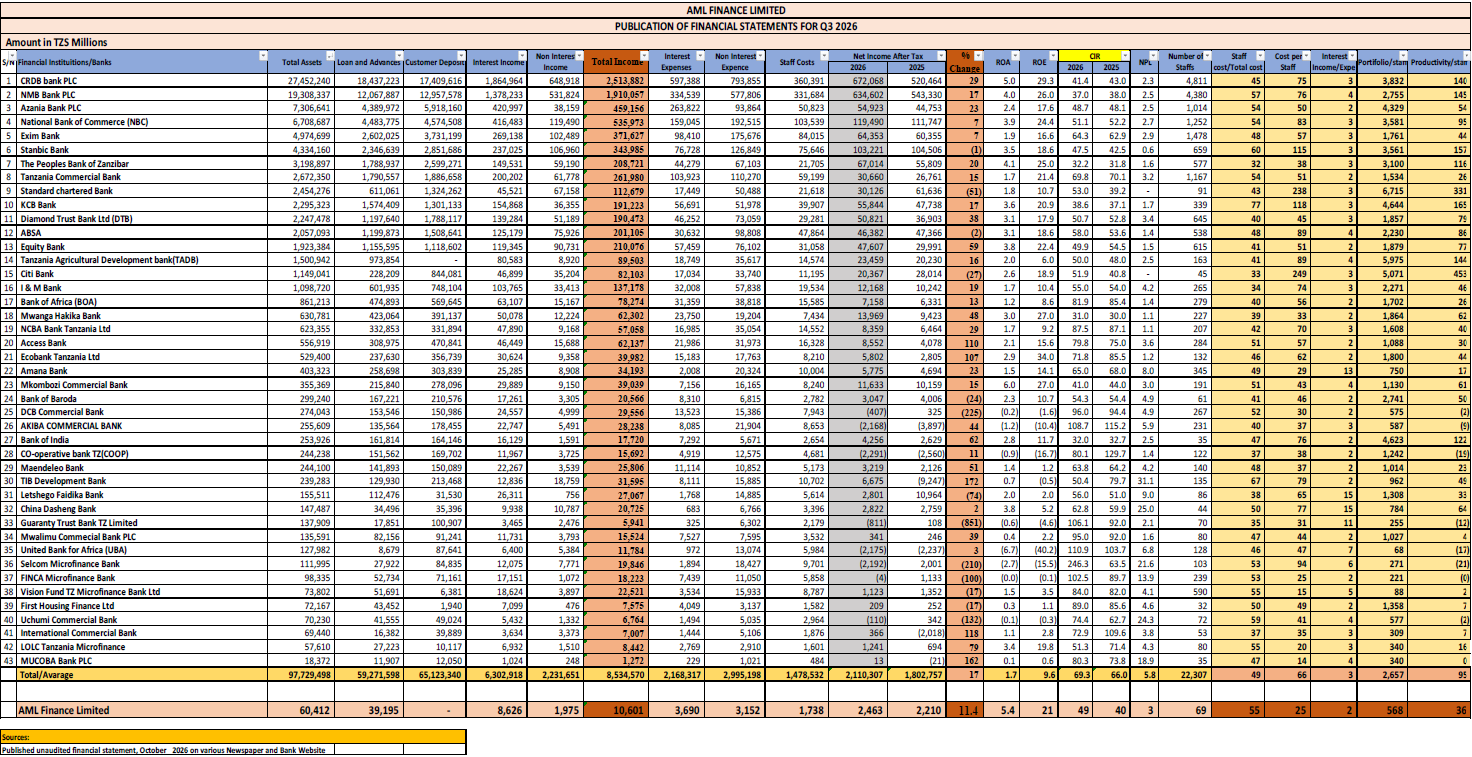
Tanzania’s banks are growing faster than their profits. This paper, prepared by Reginald Massawe, Managing Director of AML Finance Limited, examines the banking sector’s performance for the nine months ended 30 September 2026. Across 43 institutions, assets reached TZS 97.73 trillion at the end of September, while January–September profit after tax rose 17.1% to TZS 2.11 trillion.
The paper explores the questions behind these results: why is growth not producing matching profits, why has digital expansion not reduced dependence on interest income, and why do some banks lose money while others prosper? It also asks whether Tanzania has too many banks for the size of its economy or too little financial depth; whether credit can grow far faster than GDP without creating future strain; whether falling non-performing loan ratios reflect stronger repayment or simply a rapidly expanding loan book; and whether consolidation will strengthen competition or deepen concentration. At the heart of these questions is a practical test: does new business generate enough additional income to cover its additional costs and risks?
2.0 Bigger banks dominate but growth must earn its cost
Tanzania has about 35 commercial banks against estimated 2026 GDP of USD 94.9 billion—roughly one bank per USD 2.7 billion of GDP. Kenya has 38 commercial banks and GDP of about USD 147.3 billion—one per USD 3.9 billion. The comparison suggests not simply too many banks, but a fragmented lower tier: the 16 institutions with assets above TZS 1 trillion hold 92.8% of industry assets and earn 96.3% of its profit. CRDB and NMB alone earn 61.9% of profit from 47.8% of assets and account for 79% of the profit increase.
Their combined asset share has stayed near 48% since 2023, so their dominance is strengthening mainly through earnings rather than a much larger market share. The size paradox is that large banks dominate industry profits, yet some smaller banks earn strong returns while others lose money. South Africaʼs five largest banks hold roughly 90% of banking assets; Tanzania is less concentrated at the top, but far more uneven below it. Size alone does not explain performance.
The growth paradox is equally important. Private-sector credit was reported to be growing 34.2%, compared with real economic growth of about 6% and nominal growth of about 10.6%. Between September 2024 and September 2026, reported assets grew 59.9% and loans 65.7%, but nine-month profit rose only 31.1%. Coverage changes qualify the comparison.
New loans incur funding costs and loan-loss allowances before earning a full periodʼs interest, but delayed profits cannot justify weak returns indefinitely.
Marginal income means revenue from additional business; marginal cost means the extra funding, servicing and expected loan losses it brings. The difference is marginal profit before tax. A new loan may be profitable yet earn less per shilling than existing loans, reducing the bankʼs average return. It must also offer shareholders a reasonable reward for the money and risk committed. Higher lending rates do not guarantee better returns if deposit costs rise too.
3.0 Banks can move from losses to profits and from small to large
A bank’s current position need not determine its future. TIB Development Bank moved from a TZS 9.25 billion loss to a TZS 6.68 billion profit over the period under review. Azania’s assets increased from TZS 3.68 trillion in December 2025 to TZS 7.31 trillion in September 2026, lifting it from fifth to third by assets. These examples demonstrate movement towards profitability and greater scale, although growth and profitability remain separate tests of success.
Rankings can move in either direction. Between December 2025 and September 2026, Standard Chartered re-entered the top ten, rising from eleventh to ninth, while Diamond Trust Bank slipped from ninth to eleventh despite asset growth. The proposed merger of two established banks could reshape rankings further: combined September assets of approximately TZS 8.77 trillion would place the institution ahead of Azania, if completed on those figures. Consolidation could strengthen competition with the two largest banks while increasing market concentration.
Eight smaller institutions nevertheless report losses, including Akiba Commercial Bank, DCB and UBA. Smaller institutions’ combined profit growth falls from 45.9% to 13.5% when TIB’s turnaround is excluded, showing how one recovery can make the group appear stronger. Conversely, Mwanga Hakika and Mkombozi earned TZS 13.97 billion and TZS 11.63 billion respectively, confirming that smaller banks can be profitable.
These contrasting results require bank-level investigation. Losses may reflect insufficient income, expensive funding, high operating costs, loan-loss provisions or a combination; the figures alone cannot establish the main cause. Marginal income and marginal cost help assess whether additional business improves profitability, rather than simply enlarging the balance sheet.
The Four Disciplines of Execution can guide improvement: clear targets, controllable actions, visible progress and regular accountability. Boards should require evidence-based diagnosis, measurable milestones, named owners and deadlines. Depending on the findings, responses may include stronger income generation, repricing, cost restructuring, better collections, a narrower market, partnership or merger. Fresh capital should support sustainable profitability. The ambition should be a stronger bank, with size serving that objective.
4.0 Better loan repayment still faces weather risks
Bank of Tanzania (BoT) figures show non-performing loans (NPLs), meaning loans with serious repayment problems, falling from 5.8% of loans in December 2022 to 4.4% in 2023, 3.4% in 2024 and 3.1% in November 2025. This creates another paradox: credit can expand rapidly while the NPL ratio falls, because new loans increase the denominator before repayment problems have time to appear. Banks should therefore examine the amount and age of troubled debt, revised repayment arrangements, write-offs and funds set aside for losses.
The weather presents yet another paradox: El Niño warnings had raised expectations of heavy rains from September, yet by the time of writing in November, the experience has been heating rather than downpours. Businesses and lenders therefore face the challenge of preparing for heavy rains, prolonged heat, neither—or both at different times or in different locations. The practical response is to remain flexible, avoiding decisions that depend entirely on any one forecast.
5.0 Technology must improve earnings and service
Non-interest income (NII), including fees and foreign-exchange earnings, rose from TZS 1.66 trillion in January–September 2024 to TZS 2.23 trillion in 2026. Yet its share of total income fell from 28.0% to 27.4% in 2025 and 26.1% in 2026. The paradox remains: digital activity is expanding, but income is becoming more dependent on interest.
Technology must be judged by measurable results. Banks should compare spending on systems, software, cybersecurity and outsourced services with verified improvements in income, costs and customer service.
More transactions alone do not establish better returns. Whether digital investment is improving earnings remains a question for bank-level evidence.
Artificial intelligence (AI) adds another question about future productivity. Staff numbers rose about 6.9% in 2026 while assets grew 30.7%, but this does not establish an AI contribution. Banks should track service speed, fraud losses, total transaction costs and output per employee, including outsourced work, before attributing improvements to technology.
6.0 Conclusion and Suggestions
Tanzania’s banking industry is expanding faster than the economy and faster than its profits. Many banks coexist with concentrated earnings; credit can surge while NPL ratios fall; financial inclusion can improve while productive-sector depth remains limited; and digital expansion can coincide with a falling non-interest income share. The proposed merger adds a further paradox: stronger competition for third place could also increase market concentration.
Banks should judge growth by marginal profit: whether additional income covers additional funding, operating and loan-loss costs while rewarding shareholders fairly. Lending plans should match available funding and capital, preserve cash for withdrawals and support businesses with credible repayment capacity.
Boards should investigate individual banksʼ results before attributing success or failure to size or technology. Digital investment needs measurable income, cost and service outcomes; loss-making banks need recovery milestones grounded in their own diagnosis. Weather preparedness should cover both continued heat and possible heavy rains.
To assess banksʼ contribution to Vision 2050, we should look beyond loan growth to whether their lending helps businesses produce more, creates jobs, improves access to reliable financial services and earns sustainable profit.
Proudly Presented by
Mr. Reginald Massawe
Managing Director, AML Finance Limited